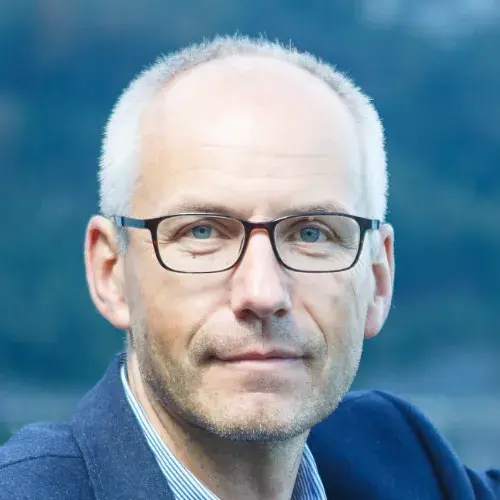
Mr. Strüby, could you briefly introduce yourself — what role did you have in the municipality of Schwyz's "town centre development" project?
I have been supporting the municipality of Schwyz as an external project manager on the "Zeughausareal Development Axis" commission. My work for the municipality in this context began with the takeover of the site from armasuisse's holdings over ten years ago and focuses, with varying intensity, mainly on strategic, business and organisational matters.
Since the administrative building at Bahnhofstrasse 15 was becoming vacant as the administration moved out, freeing up another site in the centre of Schwyz, the municipal council faced the question of how to handle this site, which is owned by the canton. Various parties and interest groups started a discourse on this and tried to position the topic politically. Since Bahnhofstrasse 15 is located in the village centre, the municipal council faced not just an isolated site-development question but one connected to the town centre development in the heart of Schwyz. The starting point was thus several development sites within the municipality of Schwyz.
What was the starting point for using BrainE4?
«BrainE4 was convincing because contributions are collected, rated by participants, and then weighted in a robust way.»
The municipal council did not primarily want to survey the positions of individual parties or interest groups, but rather gain a broad, as unbiased as possible picture from the population.
The town centre development was at the heart of it: What moves people? Which concerns have priority? The first survey provided the basis for the municipal council's strategy workshop; in a second phase, the results were validated and sharpened using closed questions.
«The questions were relevant and participation was genuine.»
How did BrainE4 come into play? The canton of Schwyz is considered rather reserved toward new procedures. Was that an issue?
That perception exists. Precisely for that reason, the municipality's openness was remarkable. What mattered was not the technology itself, but the question of which instrument gives the population genuine room for their own ideas. BrainE4 was convincing because contributions are collected, rated by participants, and then weighted in a robust way. This creates a well-founded basis for strategy, the strategy workshop and validation.
You only set four questions. Was that reduction difficult?
Yes. When you talk to the population, the temptation to ask as much as possible is great. But credible results require focus. The four questions clearly framed the topic while still leaving enough room for participants' own contributions. The fact that participants on average completed around 150 opinion duels shows: the questions were relevant and participation was genuine.
«The results don't depend on individual people, but on the participation of the population.»
You had set nine hypotheses for each question; the population mostly rated their own ideas higher. How did the municipal council take that?
Not disappointed — quite the opposite. For the municipal council it was valuable to see that the population contributes its own ideas and also rates them against each other. Looking back, perhaps even fewer predefined hypotheses would have been needed. Over 1,000 own inputs and only a few provocative contributions show that people took the topic seriously. That strengthens the quality of the results.
Was there a concern that organised groups might manipulate the results?
That concern often exists with digital participation formats. In this project it became clear: the platform ran stably, and additional waves of communication broadened the support for the results rather than distorting them. What matters is that many people participate and rate each other's contributions. This way, individual interests are put into perspective and the actual needs become more visible.
Over ten percent of the population took part. What does that mean to you?
For a municipality like Schwyz, that is an extraordinarily strong result. It shows that the municipality framed the topic correctly and communicated very consistently. What is especially valuable is the broad distribution of participants: active and less active people as well as younger and older people. Participation doesn't happen by itself; it requires timing, clear messaging and professional guidance.
«My conclusion is very positive.»
Personnel changes are coming up in the municipal council. Will the insights from the dialogue still be preserved?
Yes. The results don't depend on individual people, but on the participation of the population. They form a documented basis that remains valid even through personnel changes. This is valuable for new members of the municipal council: they don't start from zero but can rely on traceable statements from the population.