


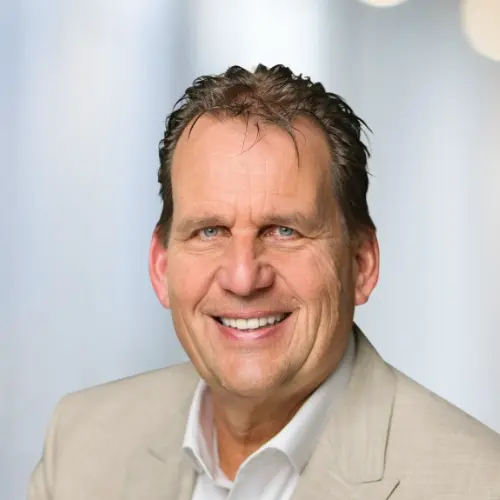
Matthias Schupp, CEO, Medartis«Euphoria is slowly building.»
Mr. Schupp, what qualities make a pioneer?
Does that apply to you?
You said courage is a trait of a pioneer. Courage means overcoming fear. When have you felt fear?
Overcoming?
Is that why your children now speak Russian?
We live in uncertain times. Where do you see opportunities or risks for yourself and your company?
Digital transformation. It’s a huge opportunity. But it’s also a topic that many of our employees fear. «Oh, this will overwhelm me. It will eliminate my job.» Over the past four years, I’ve especially embedded this deeply in our cultural journey. Engaging people and showing them that digital transformation has been part of our lives for decades. This often goes unnoticed. Telex, landline phones — you still remember those. Today, hardly anyone uses a landline anymore. Then came fax and email. Documents moved from paper folders to computers.
And today, we’re talking about AI.
Which is far from being fully debated yet.
When I talk about upheaval, I also mean the political situation.
I take a somewhat more relaxed view. I was in El Salvador shortly after the civil war ended. In 2000, I was in Russia, where the 1998 financial crisis left clear marks and meant a major upheaval. I’ve just returned from Brazil after 13 years and was actively involved in Argentina. I’ve experienced disruptive political changes and have learned to cope with them and maintain a certain distance.
We tend to always see the negative first. Those tariffs from Trump. An SRF reporter asked me: «Are you in shock?» I wasn’t. I dealt with it early on. Trump had announced it. I said early that it would be regulated. The fact is: it was first 31%. Then Trump suspended them. After that, it was 10% and later 50%. No one knows. We quickly took internal countermeasures and will adapt to the new reality.
That was a lesson in approaching things quite relaxed and waiting to see what happens. I think Brazil was a tough school.

So you worked for Straumann then.
You were able to contribute yourself there, right? Or did you have to execute what you were told from Basel?
Of course I was able to contribute. In 2012, we acquired the family-owned company Neodent, which was the third-largest player in the Brazilian implant market with less than 30% share. Due to my Latin America experience and language skills, I was well suited for the role. However, it turned out that the company was actually a turnaround candidate and appeared healthier externally than it really was. There was a risk of impairment of the balance sheet values.
The company was dressed up for the sale. But after six months of analysis, I came to the conclusion that Neodent had the potential to become an international player.
Growth resumed in 2014. By November 2024, when I left, the market share in Brazil was well over 60%, and in terms of volume, Neodent had the largest implant production in the world.
I want to come back to the pioneer. As a pioneer, you want to create something new and extraordinary. What else is on your wish list in that regard?
How?
And what is your dream for the world?
Do you have role models?
No, not really.
So Mandela and your wife are your role models?
When it comes to new developments, you as CEO have to deal with internal and external resistance. What are your strategies and experiences?
I listen. But I’m also very transparent. I ask for arguments, contribute my own, and am always open to robust dialogue.
What doesn’t work at all for me are statements like: «That won’t work», «We’ve always done it this way» or «That’s difficult.» If no arguments follow, I’m also someone who sometimes makes top-down decisions.
Basically, for me it’s about dialogue, discussion, and trying to reach common ground. But ultimately, I’m the one who makes the decision and bears the responsibility.
You surely experienced differences in mentality.
Where do you see the limits of dialogue?
How does listening work for you?
It starts with an open office door. Anyone can come in. Not just my direct team. Anyone can come, anyone can talk to me. I’m also often on the move within the company, present and in close exchange with people.
Some interesting ideas come up that way. Then we schedule a separate meeting and delve deeper into them.
Employees also come with questions, for example about my monthly video messages. That way, they are always well informed about what is happening and being decided in the executive floor on the 8th floor. That raises questions. This helps me sense whether the strategy is being understood.
This is complemented by the exchange through my communications department and, of course, social media with a focus on LinkedIn. This cultural communication apparatus has developed over years. And finally, I also produce a weekly podcast for radio stations in Brazil.