


Leadership Dialogue
Markus Grenacher, Fire Inspector, Solothurn Building Insurance (SGV)
«A workshop won’t get you there.»
How do you get 600 volunteer fire service officers to revise their canton’s most important rulebook, willingly and with real commitment? Solothurn Building Insurance (SGV) broke new ground in revising the fire service Command Files. Instead of a rigid formal consultation in which only the loudest voices are heard, it invited commanders and officers to a digital «Ideenduell» (idea duel) run by BrainE4. In this interview, Fire Service Inspector Markus Grenacher, his deputy Daniel Schaer and Head of Procurement Rolf Vogt talk about surprisingly high engagement, valuable insights, and why genuine participation takes the courage to face the truth.
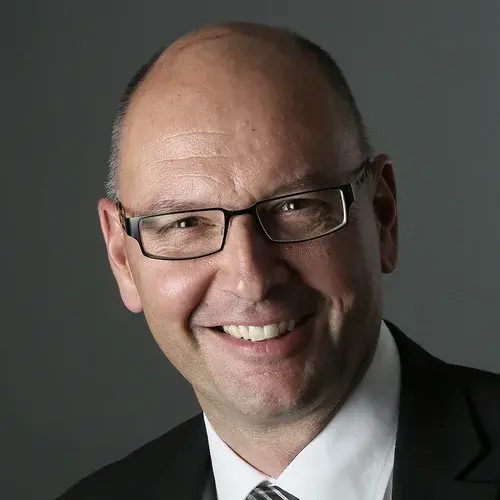
205 fire service officers revise their own rulebook. Thomas Küng in conversation with the leadership of Solothurn Building Insurance (SGV) about the fundamental overhaul of the cantonal Command Files (Kommandoakten) for the fire services.
Mr Grenacher, what specific problem did you want to solve with the complete revision of Solothurn’s Command Files?
Grenacher: «Problem» isn’t quite the right word; it was a question of keeping up with the times. Our Command Files, which are essentially the «operating manual» for the fire services in the canton, were no longer fully up to date after the legislative amendment in 2025, neither in content nor in presentation. The loose-leaf catalogue was simply outdated. So we decided on a comprehensive revision. We wanted to move away from the outdated «binder» towards a modern solution that genuinely helps people on the ground in their day-to-day work.
«A workshop won’t get you there. All you hear are the loudest voices.»
A revision like this would traditionally be handled through the cantonal fire brigade association. Why did you choose a broad leadership dialogue instead?
Grenacher: Because otherwise we would only have had the perspective of the three large fire brigades, and the needs of all the others would have been lost. We wanted to reach the key people on the ground: commanders and officers, but also specialists such as equipment managers, vehicle officers and administrators. Comprehensive feedback from across the canton was important to us: What do you need in your daily work, what’s missing, what’s superfluous?
How did you come into contact with BrainE4?
Grenacher: I had been following the method through various channels and contacted Andreas directly. The deciding factor was Renato Mathys, the Fire Service Inspector of the Canton of Zurich, who had used BrainE4 successfully there. A traditional workshop won’t get you there. You mainly hear the loudest voices, and the quieter ones get lost.
«A one-third participation rate is an excellent result in a volunteer system.»
Why didn’t you simply assign the survey to your own department as an internal task?
Grenacher: Because transparency creates acceptance. In previous revisions, we decided internally what was supposed to be good. Over time, you can lose some perspective; after all, you’re no longer on the front line every day. The idea, to put it bluntly, was to lay all our cards on the table and give people on the ground a real say in shaping the outcome.
You contacted around 600 officers and leaders. Why not all 3,500 fire service members in the Canton of Solothurn?
Grenacher: If I survey 3,500 people, many of whom don’t actually use the Command Files directly in their daily work, it dilutes the results. We deliberately targeted the leaders and specialists who work with them every day.
«Little effort, big return.»
In the end, 205 officers took part, a participation rate of 34 percent, with an average of 113 decisions per person. How do you rate that?
Grenacher: To be honest, at the start I thought nobody would be interested in the Command Files. So I’m all the more pleased: a one-third participation rate is an excellent result in a volunteer system. The average of 113 decisions shows how seriously people engaged. We also had a good cross-section, from Category 1 fire brigades all the way to the three large ones.
1/3


«The moment the dialogue closed, I already had the results.»
An Ideenduell is an unfamiliar format for fire service officers. How did people get started?
Grenacher: It was new, of course. We had never taken part in a leadership dialogue like this ourselves. In hindsight, it would have been smart to run through the process once within the leadership team beforehand, to understand even better what participants could expect.
Vogt: Our people are used to tackling an issue and getting to a result quickly. In a dynamic leadership dialogue like this one, the picture only emerges over time. You have to weigh things up and get involved. That felt unfamiliar at first. But over time, people clearly enjoyed it.
What was the immediate reaction on the ground?
Grenacher: We presented the topic at four regional briefings to a total of 75 commanders. The feedback was overwhelmingly positive, right up to a spontaneous «Hats off, thank you for bringing us on board.» Those who stuck with it quickly recognised the added value.
«The benefit can’t be measured in Swiss francs.»
How much preparation did it take on your side?
Grenacher: Very little. Andreas had scheduled three hours for the strategy workshop; we were done after one hour and fifty minutes.
Vogt: I was pleasantly surprised by how little time we had to invest before the project was up and running. That’s exactly what we had hoped for: little effort, big return.
Schaer: I can only confirm that. The preparation effort was small, but the result was tremendous and very detailed.
«At the push of a button, you have a finished, well-prepared case.»
Was there a moment when you felt particularly clearly that the method was working?
Grenacher: I kept checking the live statistics and could see how committed people were in contributing their own ideas. At one point, when the curve flattened, it turned out we had accidentally sent out the wrong link. The responses came back immediately, an excellent sign of how attentive and engaged people were. The summer holidays weren’t the ideal time window on our part, but participation picked up significantly again right after a targeted reminder.
Schaer: That second wave after the reminder was the best moment for me. The numbers rose noticeably: new people joined, and some rankings shifted once more as stronger arguments from the ground were voted to the top.
More than 90 percent of participants have over ten years of service experience. Was that important to you?
Grenacher: Very important. There’s little point in asking someone who has only been in the role for six months. We wanted the experienced practitioners who work with the rulebook every day. I’m very pleased that precisely these people took part in such numbers.
«For me, the result is truly outstanding.»
In the Canton of Zurich, some officers were sceptical about involving so many people at once. Have you experienced that too?
Grenacher: No, quite the opposite. It was greatly appreciated here. All officers were reached directly.
Was there any feedback that surprised you in terms of content?
Grenacher: Yes. I was pleasantly surprised by how openly people discussed topics such as the taxation of fire service pay, an area some initially rated as less relevant, even though it falls within their own responsibility. That shows us where we need to communicate more clearly in future.
2/3
«It does cost something, but for me it’s worth every franc.»
What gave you the most food for thought?
Vogt: For me, above all, the clear feedback on our vehicle procurement guidelines. People on the ground want more flexibility. That’s a valuable pointer we can now take up to adapt the guidelines more closely to practice in future.
Schaer: The key insight was that the troops don’t want a massive tome, but a concise format, ideally a checklist. Quickly accessible and available digitally.
What insights did BrainE4’s decision matrix give you that a traditional consultation wouldn’t have delivered?
Grenacher: One finding particularly pleased me: the concern that small fire brigades might be disadvantaged compared with large ones was clearly dispelled. The smaller brigades themselves firmly rejected any preferential treatment of the large ones. Everyone wants the same fair rules. In addition, valuable side issues came up that we hadn’t had on our radar before.
Schaer: One point that stuck with me: the large fire brigades no longer want to be governed by fixed categories, but want a say in how they develop. That’s an interesting reaction to a structure that has grown historically.
Vogt: The big difference compared with a traditional consultation is the starting point. There, people only react to an existing text. Here, people could bring in their own topics, some of which were ranked very high.
«That’s exactly why you ask: whoever listens ends up with a better rulebook.»
How quickly did you have usable results in hand?
Grenacher: We deliberately closed on 4 September, just before our regional briefings. The day the dialogue ended, I already had the results, instead of waiting months for an analysis. That’s a major plus. By 5 September, the report was complete and ready for publication.
«Transparency creates acceptance.»
Others talk about saving money with this format. Is that a factor for you?
Grenacher: I don’t think we’re primarily saving money with it. That was never our goal. The benefit can’t be measured in Swiss francs: we gain acceptance and show people that we take them seriously.
Vogt: That was never our focus either. In the area of subsidies, the wishes of the people on the ground will probably cost a little more, but we now know exactly where funds will have the greatest impact.
The report shows a clear demand for digital, mobile access to the files. How are you addressing that?
Grenacher: That had been on our radar for some time. We were aware that the current format is no longer fully up to date. That’s why we took this approach: first find out what matters in terms of content, and only then tackle the technical implementation.
«I was pleasantly surprised by how little time we had to invest before the project was up and running.»
Were there also wishes that are hardly feasible?
Grenacher: Yes, for example the wish for more municipal autonomy in organising the fire service. The law clearly stipulates that every municipality must organise a fire brigade. We address such points clearly in the new Command Files: we listen, but we still bear the responsibility.
How did you get on with the BrainE4 decision matrix yourself?
Grenacher: I was happy to read up on it a bit. The matrix is actually self-explanatory. What’s interesting is what lies behind it: how heavily something is weighted, where there is particularly strong consensus. I have a good feeling that we’re heading in the right direction with it.
What is your overall verdict on the collaboration and the result?
Vogt: The support from Andreas was excellent. He explained everything efficiently and clearly. Our effort was minimal, and the result convincing: at the push of a button, you have a finished, well-prepared case.
Schaer: I can only confirm that. I was delighted by the efficiency. It was fascinating to see how the ranking shifted again during the dialogue as new input came in. For me, the result is truly outstanding.
Grenacher: I can only agree. I had already spoken with Andreas once about a large dialogue for the entire fire brigade association in the Canton of Solothurn, with more than 3,500 people. At the time, we put it on hold for budget reasons. After what I’ve now experienced first-hand, I’m convinced: this is the right way to go. I receive the analysis, including the prioritisation, fully finished. It does cost something, but for me it’s worth every franc.
«The preparation effort was small, but the result was tremendous and very detailed.»
Who would you recommend BrainE4 to?
Grenacher: Really, anyone who has a genuine question. I would even explicitly encourage companies to involve their employees this way. By comparison, traditional surveys with the same old tick-box questions quickly feel dusty. We ourselves also want to use it for our own strategy development. The format can be applied to any organisation, including a municipality. As far as I’m concerned, the range of applications is wide open.
Vogt: Whether it works in politics, I don’t know. There, it’s usually about deciding between two positions. That’s a different starting point. But in principle, I fully agree.
Schaer: I have nothing more to add. Mr Grenacher has it exactly right.
Is there anything else you would like to add?
Grenacher: Just this: BrainE4 is welcome to cite Solothurn Building Insurance as a reference, including to anyone who is still somewhat sceptical. We are always available for an exchange. We are very satisfied, especially with the ratio between our effort and what comes out of it. And even if there’s some critical feedback now and then: that’s exactly why you ask. Whoever listens ends up with a better rulebook.
Online Dialogue:
205
digital interviews
34
%
participation rate
Interviewees:
Markus Grenacher, Fire Service Inspector, Solothurn Building Insurance (SGV)
Daniel Schaer, Deputy Fire Service Inspector & Head of Fire Service Training
Rolf Vogt, Head of Procurement & Subsidies
Interview: thk
3/3

100% Swiss Made
Copyright © 2026 BrainE4